
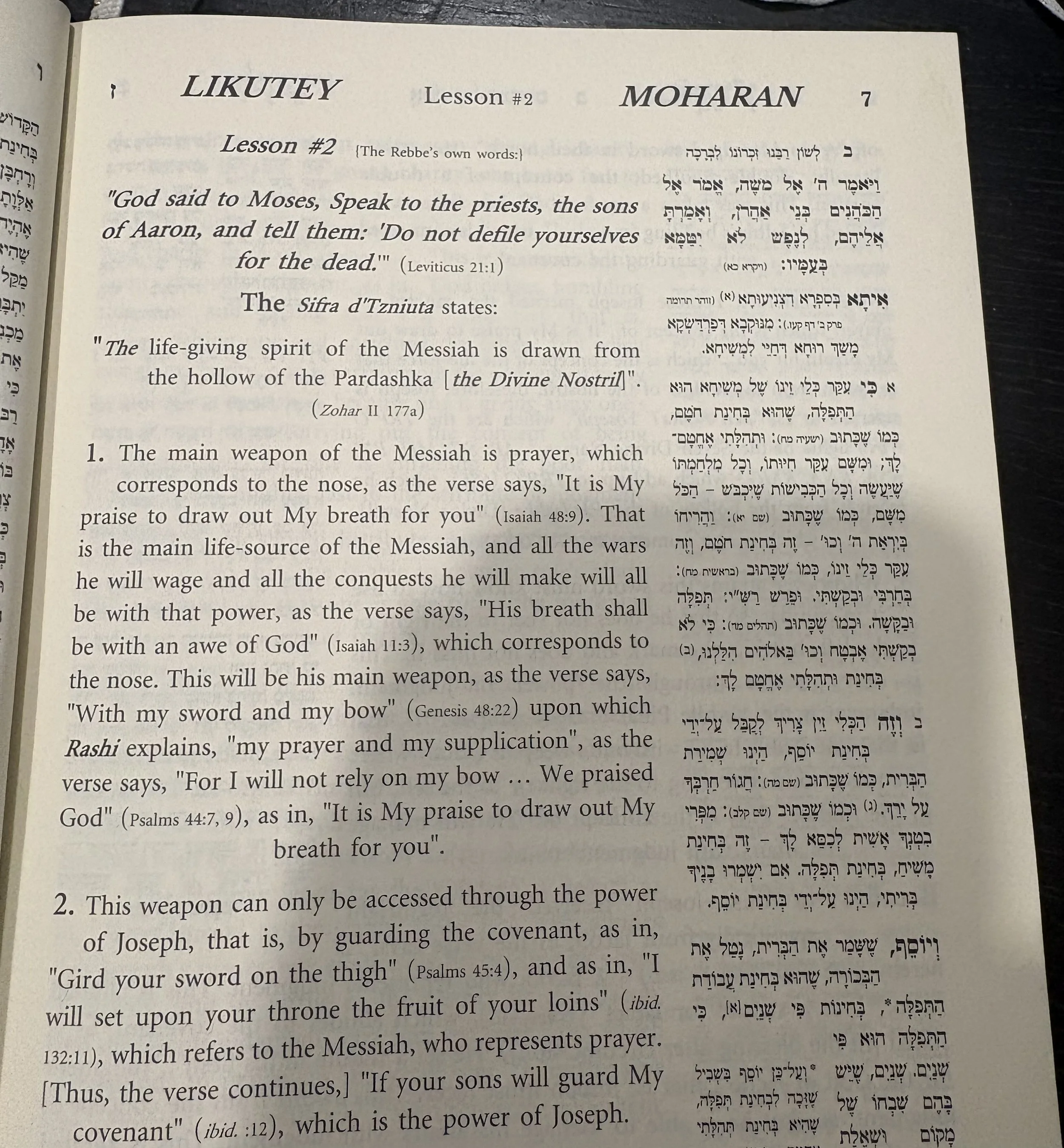
Likutey Moharan, Lesson 2, opens with a line from the Sifra d'Tzniuta in the Zohar: the life-spirit of Mashiach is drawn from the hollow of the nostril, the nukva d'pardashka.
Rebbe Nachman explains that Mashiach's main weapon is prayer, which corresponds to the nose: ותהלתי אחטם לך, "My praise I draw out like breath for you" (Isaiah 48:9). Then he adds a condition. This weapon can only be reached through Yosef, through guarding the covenant: "Gird your sword on your thigh."
So the text joins two things: the nose and the covenant. Mashiach ben David and Mashiach ben Yosef. I want to show how the body itself joins them, step by step.
1. Nose breath goes up before it goes down
When you breathe through your mouth, the air goes straight back and down the throat into the lungs.
When you breathe through your nose, the air first rises into the nasal cavity. The roof of that cavity sits right under the front of the brain, separated from it by a thin plate of bone. The nerves of smell pass through tiny holes in that bone, straight into the brain. The air doesn't enter the brain, but it passes right at its doorstep. Only then does it turn and go down into the body.
Nose breath is breath that goes through the head first.
2. What it does in the body
In the nose, the air is warmed, filtered and moistened. It also picks up nitric oxide, which is made in the sinuses. Nitric oxide widens the blood vessels in the lungs, so oxygen passes into the blood more easily.
The nose is also narrower than the mouth, so the breath naturally slows down. Slow, deep breathing is the pattern of a body at rest. Fast, shallow breathing through the mouth is the pattern of stress and effort.
The mouth gets air in. The nose brings life in.
3. What it wakes up in the brain
Smell is the only sense that goes directly to the brain's emotional and memory centers, without first passing through the thalamus, the brain's usual relay station.
Research from Northwestern University (Zelano et al., 2016) found that nose breathing syncs the electrical rhythms of the amygdala and hippocampus, the centers of emotion and memory. These rhythms peaked as people breathed in, and faded when breathing was switched from the nose to the mouth. People also recognized fearful faces faster and remembered better while breathing in.
In the language of Chasidus, this is a yichud. The mind, chochmah, binah, da'as, is joined to the six emotions, the middos, which live in the body. The breath rises to the mind and then descends into feeling and into the body. That's the power of Mashiach ben David: the mind drawn all the way down into life, so that understanding doesn't stay in the head.
4. Where the seed begins
The seed is made in the body, but the command to make it comes from the brain. A small group of brain cells releases a hormone called GnRH, and that starts the whole chain that leads to the seed.
In the embryo, these cells aren't born in the brain. They form in the nose, in the tissue that becomes the organ of smell. From there they travel along the smell nerves up into the brain and settle there.
There's a condition called Kallmann syndrome where that journey fails. The person is born with no sense of smell and without sexual development. Both are missing together, because they come from one root.
So the source of the seed, the power of Yesod, also begins in the nose.
5. The end is in the beginning
Sof ma'aseh b'machshavah techilah: the last thing done was first in thought.
The nose is the place of machshavah, where breath meets the mind. The seed is the sof ma'aseh, the end of the line, where life goes out into the world and builds the next generation. And the body shows that they begin in the same place. The end is planted in the beginning.
6. Why the opening needs a guard
This is why the Rebbe says prayer, the nose, can only be reached through Yosef.
Nose breath opens the mind wide. It wakes up the emotions and brings the power of the mind down into the body. But that same flow comes down to Yesod, to the seed. An open channel can carry life, and it can also leak it. The more the mind opens, the more that power needs a place where it's kept holy.
That's guarding the covenant. It isn't a separate project from prayer. It's the other half of the same movement.
Mashiach ben David is the opening: the mind expanding and coming down into the heart and body through the breath of prayer.
Mashiach ben Yosef is the guarding: keeping the end of that flow sacred, the sword girded on the thigh.
Opening and guarding in one motion. Expanding and protecting. Digging deep and keeping the well clean.
7. Simply
When you daven, breathe through your nose. Let the breath go up before it goes down. And guard the place where that breath ends up.
The breath and the covenant come from one root. Keep both, and the life of Mashiach can flow through you.
